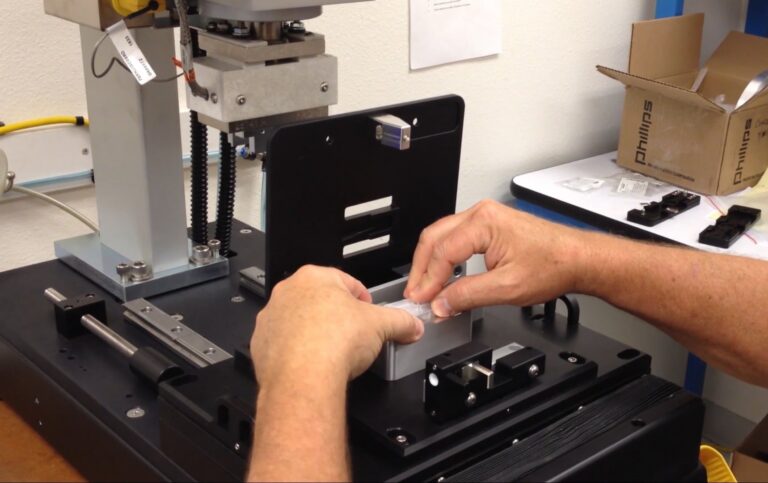
This video showcases a Thermal Press International manual thermal press being used during the process development phase of an automotive PCB heat staking application. The system provides a flexible and cost-effective solution for evaluating feasibility, optimizing process parameters, and refining tooling design before transitioning to production.
In this application, the PCB assembly is poisitioned within a custom fixture, ensuring accurate alignment of the components prior to heat staking. The operator manually lowers the thermal probe to contact the plastic posts, triggering a controlled dwell timer that allows the material to soften and form a secure mechanical bond. The process relies on precise timing and consistent application of heat to achieve uniform and repeatable results across each staking point.
Manual thermal presses are commonly used in early-stage development because they allow engineers to adjust heat, pressure, and dwell time while observing how the material responds. This level of control is critical when working with sensitive assemblies such as automotive PCBs, where component integrity and process consistency are essential.
This example highlights the role of Thermal Press International equipment in supporting customers from feasibility through production. By validating the process on a manual platform, manufacturers can confidently scale to automated systems with optimal parameters and proven results.