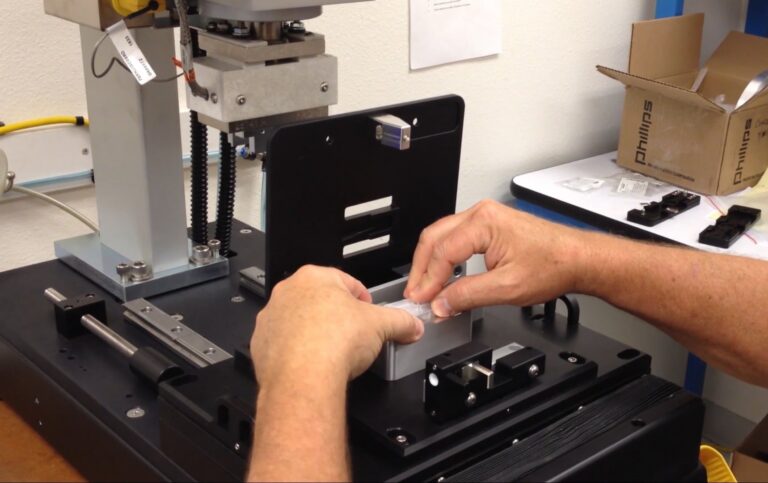
This video highlights a Thermal Press International C-Series machine performing precision heat swaging to secure a battery within a wearable medical device assembly. Heat swaging is a controlled thermal forming process used to reshape thermoplastic features, creating a strong mechanical retention without introducing vibration or particulate – making it especially well suited for sensitive medical and electronic applications.
In this application, the wearable device and battery are loaded into a custom-designed fixture that ensures accurate alignment and repeatable positioning throughout the process. Proper fixturing is critical to maintain device integrity, particularly in compact wearable assemblies where component placement and retention must meet strict performance and reliability requirements.
A key feature of this system is the integrated strip-out (anti-ejection) mechanism, designed to prevent the device from lifting or ejecting during the swaging cycle. This ensures consistent part stability as the thermal head reforms the plastic features around the battery, resulting in uniform stake formation and secure retention.
The machine is also equipped with a rotary indexing table to improve throughput and operator efficiency. While one assembly is being processed, the operator can simultaneously load and unload parts at a separate station. This continuous workflow reduces idle time and supports higher production volumes while maintaining process consistency.
During the heat swaging cycle, the thermal head applies controlled heat and force to reform the thermoplastic features, encapsulating the battery and locking it securely into place. Critical process parameters – including temperature, dwell time, and applied force – are precisely controlled to ensure repeatable results without damaging the battery or surrounding electronics.
This example demonstrates the flexibility of the C-Series platform, which can be configured with specialized tooling, multi-station indexing tables, and application-specific features to support demanding medical device and wearable technology assembly requirements.