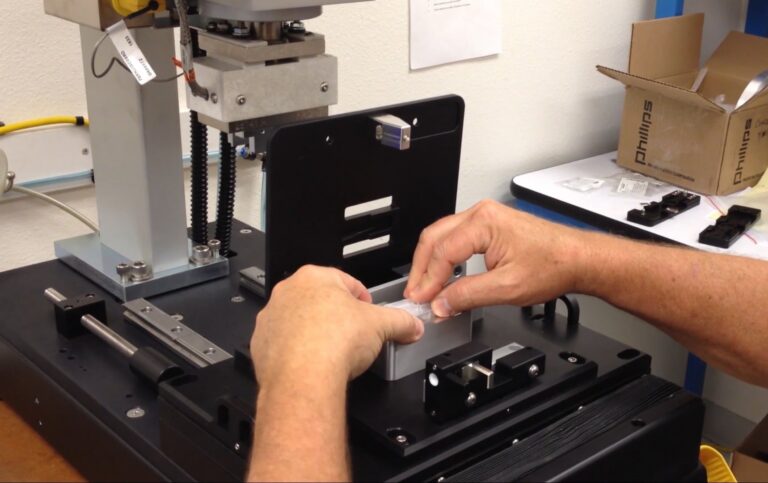
This video features a C-Series Thermal Press configured for 2-up boat port heat sealing on medical-grade bags, enabling increased throughput while maintaining precise control. Applications like this require consistent sealing performance across multiple parts within a single cycle, making accurate fixturing and alignment critical.
The system utilizes highly specialized tooling designed to securely locate and support both boat port fitments during the sealing process. Custom-engineered nests ensure proper alignment of each port relative to the bag material, helping to maintain uniform contact and consistent seal integrity across both assemblies.
A power shuttle table is integrated into the system to streamline operation and improve efficiency. The shuttle incorporates a custom-designed clamping mechanism that holds both bags firmly in place, ensuring repeatable positioning as the assemblies move into the sealing position beneath the thermal head. This design enables safe, efficient loading and unloading while maintaining consistent alignment from cycle to cycle.
During the dwell phase, controlled heat and pressure are applied simultaneously to both port locations, forming strong, hermetic seals between the boat ports and the flexible bag material. Processing two parts at once significantly improves productivity while maintaining the high-quality results required for medical applications.
Thermal Press International systems are engineered to deliver precise temperature control, repeatable force application, and application-specific tooling solutions. This example highlights how multi-part fixturing and optimized system design enable manufacturers to scale production efficiently while maintaining consistent, validated sealing performance.