
Thermal Staking Probe Tip Geometry and Design Guidelines
The geometry of a thermal staking probe tip determines how a thermoplastic post is formed and influences the dimensions, mechanical retention, and appearance of the finished stake. The following six configurations illustrate common thermal staking approaches and provide preliminary dimensional recommendations for engineers evaluating plastic assembly designs. All dimensions are expressed as multiples of the original post diameter (d). The appropriate geometry depends on the thermoplastic material, component design, required retention strength, available clearance, and desired finished appearance.High-Profile Flared Stake
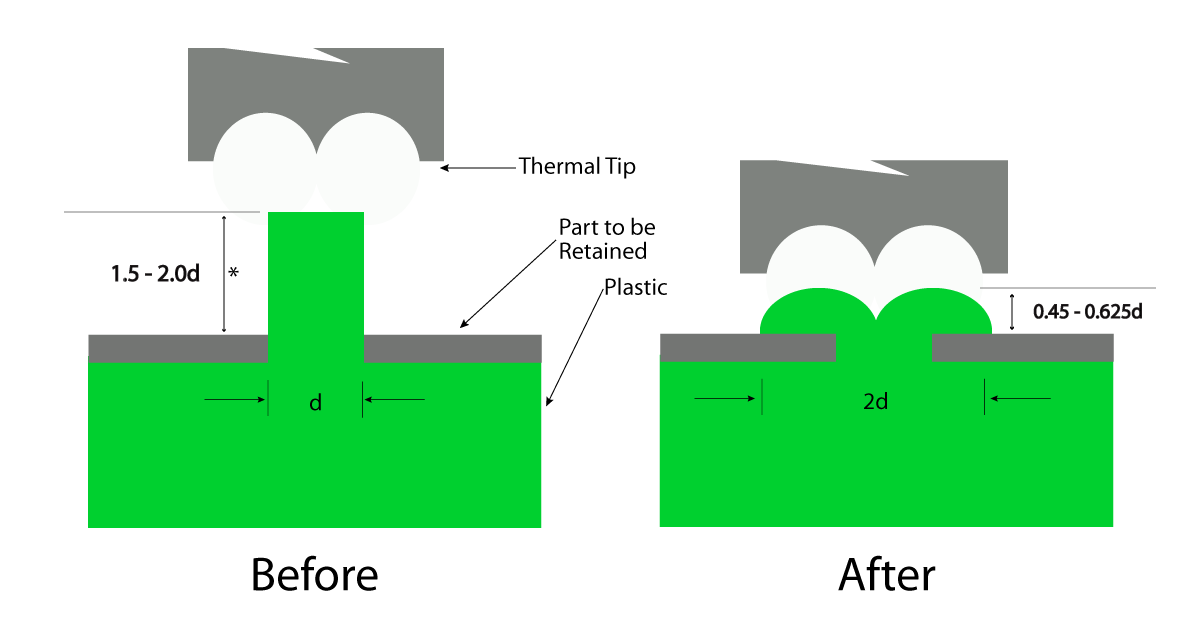
The high-profile flared stake produces a broad, flattened head that provides strong mechanical retention. This configuration is particularly suited to low-density, nonabrasive amorphous thermoplastics where sufficient post height is available to form the finished head. Preliminary dimensional guidelines:- Recommended post working height: 1.5–2.0 × post diameter
- Approximate finished head width: 2.0 × post diameter
- Approximate finished head height: 0.45–0.625 × post diameter
Design considerations: High-profile flared staking is useful where strong mechanical retention is a priority and sufficient clearance is available for the formed head. The post geometry, thermoplastic properties, and tooling must be evaluated together to achieve consistent results.
Low-Profile Flared Stake
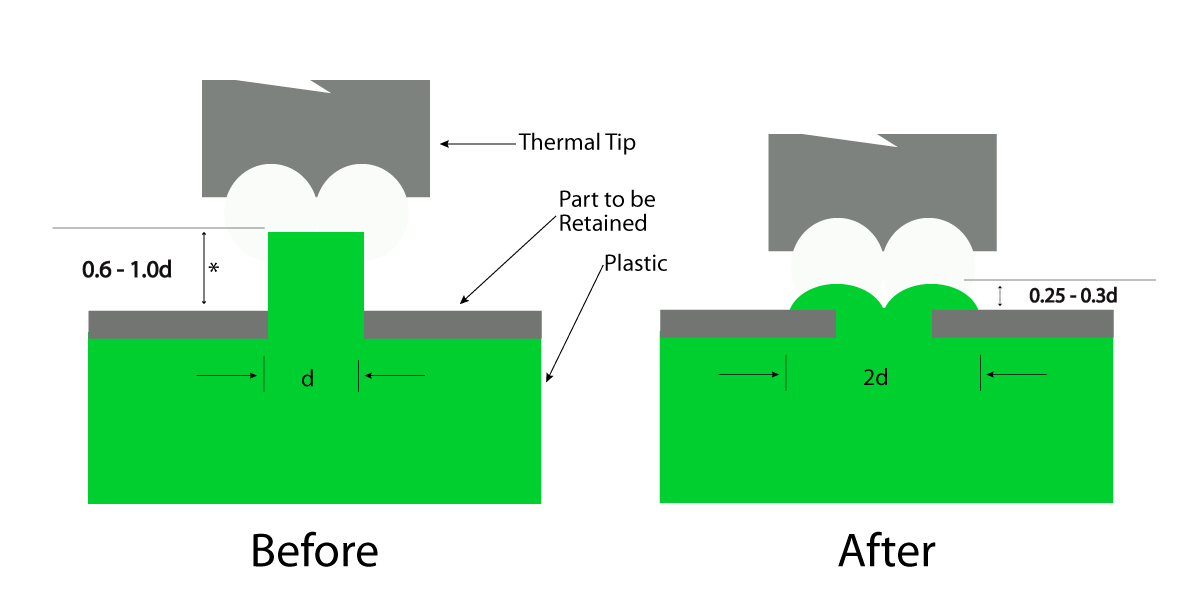
The low-profile flared stake forms a broad, relatively shallow head where assembly height is restricted. It provides a mechanical retention feature while reducing the vertical space required for the finished stake. Preliminary dimensional guidelines:- Recommended post working height: 0.6–1.0 × post diameter
- Approximate finished head width: 2.0 × post diameter
- Approximate finished head height: 0.25–0.30 × post diameter
Design considerations: This configuration is appropriate for assemblies with limited vertical clearance. Engineers should evaluate the available post material, finished head dimensions, and retention requirements when selecting a low-profile design.
High-Profile Spherical Stake
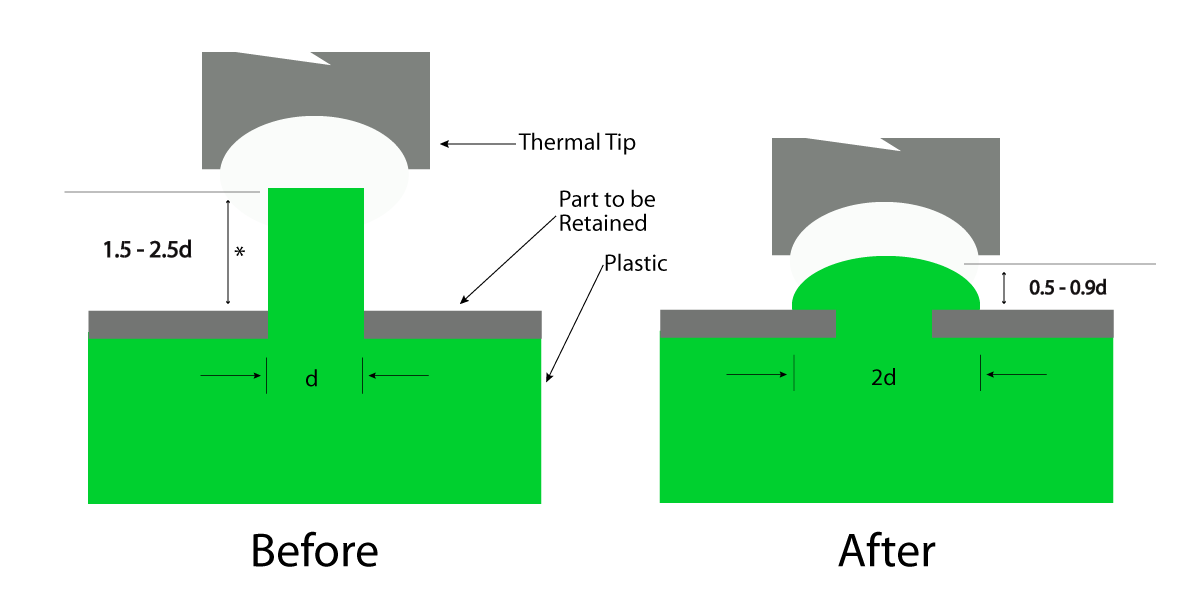
The high-profile spherical stake forms a rounded head rather than a broad, flattened profile. This configuration is useful where a rounded finished appearance is desired and may be considered for rigid crystalline plastics, abrasive-filled materials, or heat-sensitive resins. Preliminary dimensional guidelines:- Recommended post working height: 1.5–2.5 × post diameter
- Approximate finished head width: 2.0 × post diameter
- Approximate finished head height: 0.5–0.9 × post diameter
Design considerations: The rounded head geometry can be advantageous where appearance and material characteristics influence the selection of the staking method. Material response, probe geometry, and the required mechanical retention should be evaluated during development.
Low-Profile Spherical Stake
The low-profile spherical stake creates a compact, rounded head with less vertical projection than the high-profile spherical configuration. It is useful for applications where a rounded finished appearance is desired but available clearance is limited. Preliminary dimensional guidelines:- Recommended post working height: 0.7–1.2 × post diameter
- Approximate finished head width: 1.5 × post diameter
- Approximate finished head height: 0.3–0.55 × post diameter
Design considerations: Low-profile spherical staking offers a compact finished head and moderate mechanical retention. The design should be evaluated against the assembly’s clearance, material, and retention requirements.

Flush Stake
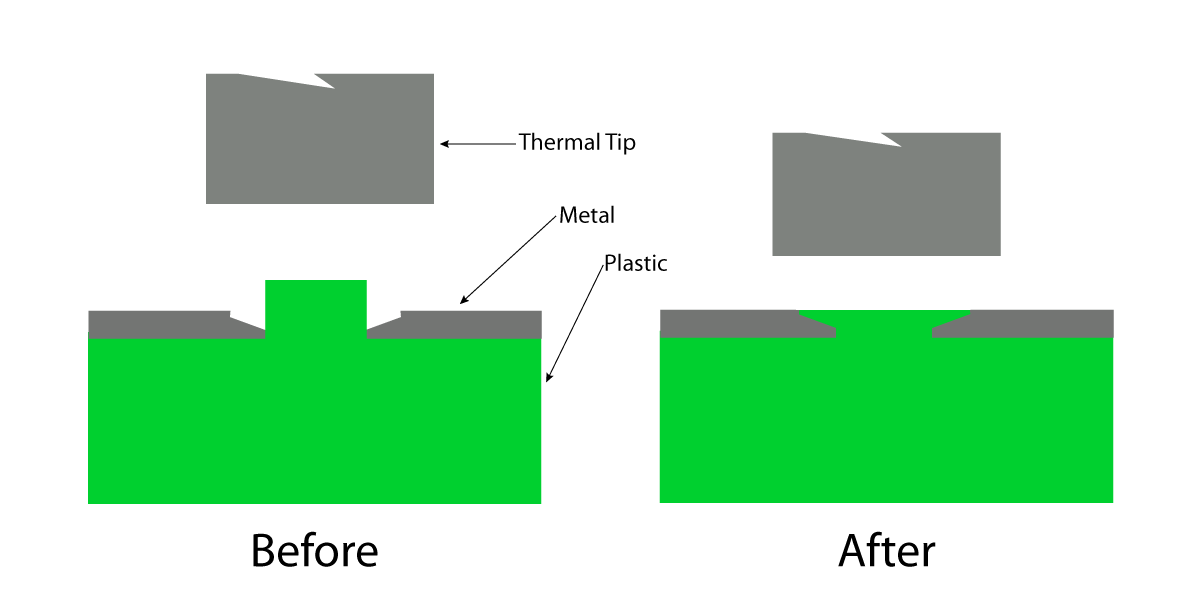
Flush staking forms a relatively flat retention feature that is level with the surrounding surface. This approach is particularly useful where a protruding stake head would interfere with adjacent components or where a smooth finished surface is required. Preliminary dimensional guidelines:- Recommended post working height: 0.6–1.0 × post diameter
- Finished head: Flat and approximately flush with the surrounding surface
Design considerations: Flush staking is appropriate where surface profile and available clearance are important. It generally provides moderate mechanical retention, making it important to evaluate the joint’s loading and functional requirements.
Hollow (Rosette) Stake
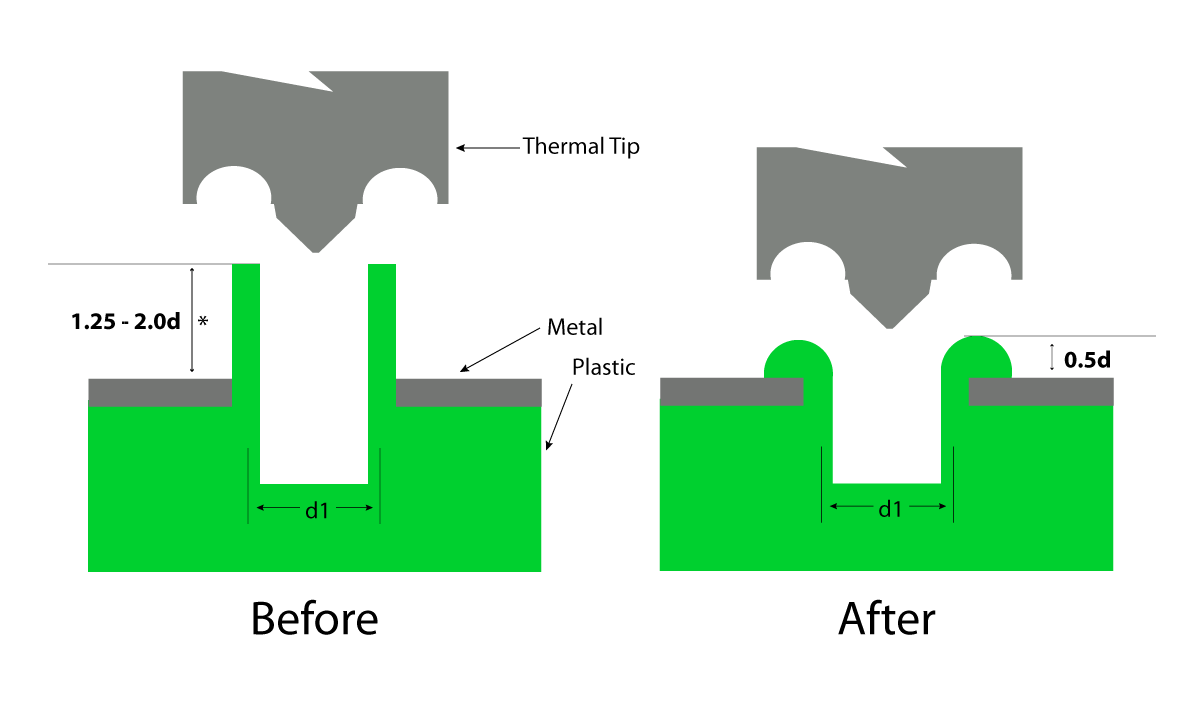
The hollow, or rosette, stake is designed for thin-wall hollow plastic posts. During the staking process, the hollow post is reformed outward to create a radial mechanical interlock that retains the assembled component. Preliminary dimensional guidelines:- Recommended post working height: 1.25–2.0 × post diameter
- Approximate finished head height: 0.5 × post diameter
Design considerations: Hollow staking is useful where a thin-wall post geometry is preferred or already incorporated into the component design. Post wall thickness, material characteristics, support, and tooling geometry are important considerations in achieving a consistent mechanical interlock.
Engineering note: The dimensional ranges presented above are preliminary design guidelines based on the Thermal Press International Thermal Staking & Thermal Insertion Design Guide. Actual post dimensions, finished head geometry, and processing conditions should be verified for the specific material, component design, and application requirements.
For additional guidance on plastic post design, tooling, and thermal staking process considerations, see The Heat Stake Advantage.