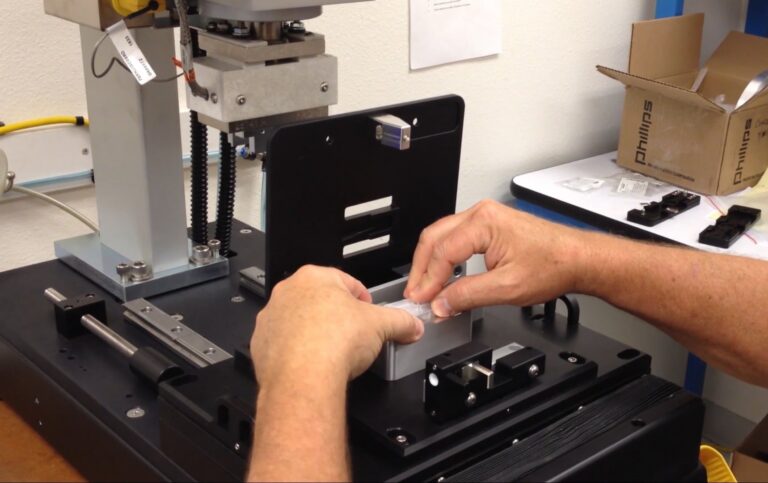
This video features a C-Series Thermal Press configured to heat seal foil onto a specialized diagnostic test cartridge. Applications like this require precise control of heat, pressure, and alignment to ensure consistent sealing performance across intricate geometries and critical functional areas.
The system utilizes custom-engineered tooling to accurately position and support the diagnostic cartridge during the sealing process. Proper fixturing ensures that the foil is aligned correctly with the sealing surface, which is essential for maintaining uniform seal integrity and protecting the functionality of the cartridge.
Once the assembly is loaded, the power shuttle table advances the fixture into position beneath the thermal head. This feature enables safe, efficient operation while maintaining repeatable alignment from cycle to cycle. During the dwell phase, controlled heat and pressure are applied to bond the foil to the cartridge, forming a reliable seal that helps protect internal components and maintain performance.
The tooling is specifically designed to accommodate the unique geometry of the diagnostic cartridge, ensuring even pressure distribution and consistent results without damaging sensitive features. This level of precision is especially important in diagnostic and medical applications where product reliability and repeatability are critical.
Thermal Press International systems are engineered to deliver precise temperature control, repeatable force application, and customizable tooling solutions. This flexibility allows manufacturers to confidently process complex assemblies while maintaining consistent, high-quality results in both development and production environments.