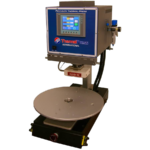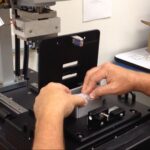
This video showcases Thermal Press International’s C-Series machine being used to heat seal foil onto diagnostic test cartridges in a 4-up configuration for efficient, high-throughput production. Applications such as this are commonly used in medical diagnostics, point-of-care testing, and reagent containment, where consistent sealing performance is critical to protecting internal chambers, preserving reagents, and maintaining product reliability.
In this process, a multi-chamber reagent pack is presented beneath the sealing heat while a carrier film transfers pre-cut foil tops into precise position over each cartridge. Locator pins ensure accurate alignment of the foil and cartridge components prior to sealing. Controlled heat, pressure, and dwell time are then applied to create uniform, repeatable seals across all four parts simultaneously.
To improve productivity and operator efficiency, the machine is equipped with a power shuttle table that allows quick loading and unloading while maintaining consistent part placement from cycle to cycle. Multi-up tooling configurations such as this help manufacturers increase throughput, reduce labor content, and improve overall process consistency.
Thermal Press systems are widely used for foil sealing applications involving diagnostic cartridges, microfluidic devices, test cassettes, trays, and other medical assemblies where precision process control and validation-ready repeatability are essential. Thermal Press International provides customized heat sealing solutions engineered to meet demanding production and regulatory environments.