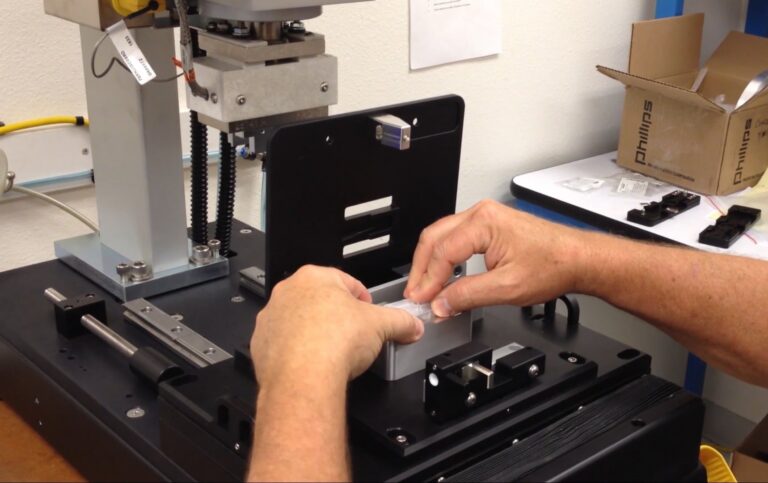
This video features an H-Series Thermal Press configured to heat seal foil onto microtiter plates in a 2-up configuration, enabling increased throughput while maintaining precise process control. Applications like this are common in diagnostic, laboratory, and life science environments where consistent sealing performance is critical.
The system utilizes a carrier film to transfer the foil, ensuring clean handling and accurate placement throughout the process. Locating pins are integrated into the fixture to precisely align both the microtiter plates and the foil prior to sealing. This level of positional accuracy helps ensure uniform coverage across all wells and consistent seal integrity from part to part.
Two plates are loaded into the custom fixture and secured in place. Once the cycle is initiated, the power shuttle table advances the assemblies beneath the thermal head. During the dwell phase, controlled heat and pressure are applied to bond the foil to the plate surface, forming a reliable seal that protects the contents and maintains sample integrity.
The 2-up configuration improves productivity by processing multiple plates per cycle, while the custom tooling ensures repeatable alignment and consistent results across both parts. This approach is especially valuable in high-volume environments where efficiency, accuracy, and process repeatability are essential.
Thermal Press International systems are engineered to deliver precise temperature control, repeatable force application, and application-specific tooling. This combination supports high-quality, validated sealing processes for microtiter plates and other laboratory consumables.