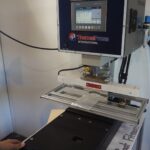
This video showcases Thermal Press International’s C-Series machine being used to heat stake two very small printed circuit board (PCB) assemblies simultaneously using a custom-engineered 2-up fixture. Applications involving compact electronic assemblies require exceptional positional accuracy, controlled heat transfer, and repeatable forming parameters to ensure secure component retention without damaging sensitive circuitry.
In this process, two PCB assemblies are loaded into a specialized nest designed to precisely locate each part prior to the staking cycle. The custom tooling maintains consistent alignment of the plastic staking posts and electronic components, allowing the thermal head to contact the targeted stake points accurately. Controlled heat, pressure, and dwell time are then applied to soften and reform the plastic posts into secure mechanical retainers that hold the assemblies in place.
To improve efficiency and operator workflow, the machine is equipped with a power shuttle table that allows convenient loading and unloading outside the heat staking zone while the thermal cycle takes place. The 2-up configuration increases throughput by processing two assemblies at once, helping manufacturers reduce cycle time while maintaining repeatable quality standards.
Thermal Press systems are widely used in electronics, automotive electronics, sensors, controls, and other precision assemblies where dependable fastening and process consistency are critical. Thermal Press International provides customized heat staking solutions engineered for delicate components, compact geometries, and demanding production environments requiring reliable long-term performance.