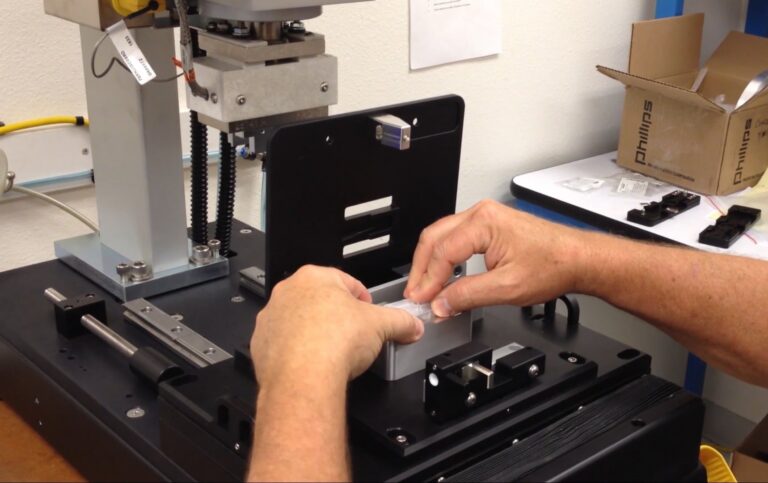
This video demonstrates Thermal Press International’s expertise in precision heat staking a medical microfluidic diagnostic card featuring seventeen extremely small thermoplastic posts. Applications such as this demand exceptional positional accuracy, repeatable heat transfer, and tightly controlled forming parameters to ensure each post is consistently staked without damaging delicate card features or surrounding components.
The system is equipped with a custom-engineered nest and clamping fixture designed to securely locate the microfluidic card during the staking cycle. This specialized tooling helps maintain alignment across all seventeen staking points, ensuring reliable part positioning and uniform results from run to run. For assemblies with very small posts, accurate fixturing is critical to achieving consistent heat formation and maintaining overall product quality.
To improve throughput and operator efficiency, the machine also incorporates a rotary indexing table that allows parallel loading and unloading while the heat staking cycle is taking place. This configuration helps reduce idle time, increase productivity, and support higher-volume manufacturing requirements without sacrificing process consistency.
Thermal Press systems are widely used in medical and diagnostic device manufacturing where precision, repeatability, and validation-ready process control are essential. Applications involving microfluidic cards, test cartridges, and other compact assemblies benefit from Thermal Press International’s ability to deliver customized thermal assembly solutions tailored to demanding production environments.