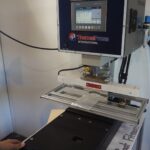
This video highlights a Thermal Press International H-Series Thermal Press configured for precision heat staking of an LED lighting array. Heat staking is a reliable and controlled method for fastening plastic components in electronic assemblies, providing strong mechanicial bonds without introducing vibration or stress that could impact sensitive circuitry.
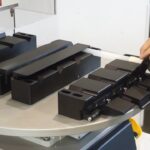
In this application, the LED lighting fixture is loaded into a custom-designed fixture equipped with a specialized clamping system. This clamping approach ensures accurate and repeatable positioning of the assembly, maintaining consistent alignment of all staking points across every cycle. Proper fixturing is critical in LED applications where component spacing, optical alignment, and overall assembly integrity must be tightly controlled.
The system utilizes a power shuttle table to improve operator ergonomics and throughput. With this configuration, the operator can safely load and unload parts in a home position while the shuttle moves the assembly into the processing area. This not only enhances efficiency but also ensures consistent cycle timing and repeatability.
During the heat staking process, the thermal head applies controlled heat and force to reform thermoplastic posts, securing the LED array components into place. Key process parameters – including temperature, dwell time, and applied force – are precisely managed to achieve uniform stake formation and long-term durability, while protecting the integrity of the LED components and circuitry.
The H-Series platform is particularly well suited for applications requiring higher force, larger work areas, or more complex assemblies. Combined with custom tooling and automoation features like the power shuttle table, it provides a flexible and scalable solution for LED lighting, electronics, and other precision plastic assembly applications.