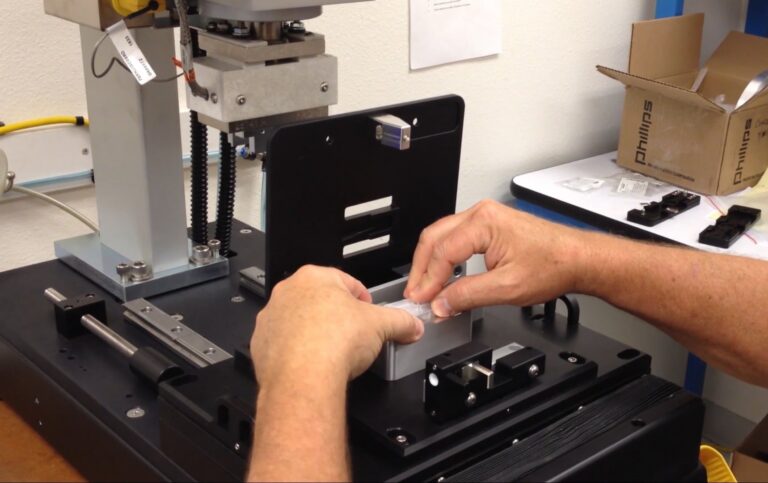
This video highlights an H-Series Thermal Press configured for heat staking automotive PCB assemblies in a 2-up configuration, enabling increased throughput while maintaining precise process control. The system incorporates a power shuttle table and custom-engineered tooling to streamline loading, positioning, and cycling.
Two PCB assemblies are loaded into the dedicated fixture, where they are securely located and supported using application-specific nests. Once the dual safety controls are engaged, the shuttle table advances the assemblies into position beneath the thermal head. This automated movement ensures consistent alignment and repeatability from cycle to cycle.
During the staking process, controlled heat and pressure are applied to form uniform, high-strength stakes. The thermal tooling is designed to match the geometry of the plastic features, allowing for precise material flow and secure mechanical retention of components without introducing stress to sensitive electronics or circuitry.
The 2-up configuration significantly improves productivity by processing multiple assemblies per cycle, while the robust fixturing ensures consistent results across both parts. This approach is particularly valuable in automotive and electronics manufacturing environments where repeatability, reliability, and cycle efficiency are critical.
Thermal Press International systems are engineered for long-term production performance, offering precise temperature control, repeatable force application, and customizable tooling packages. This flexibility allows manufacturers to adapt the same platform to evolving product designs while maintaining validated, high-quality assembly processes.