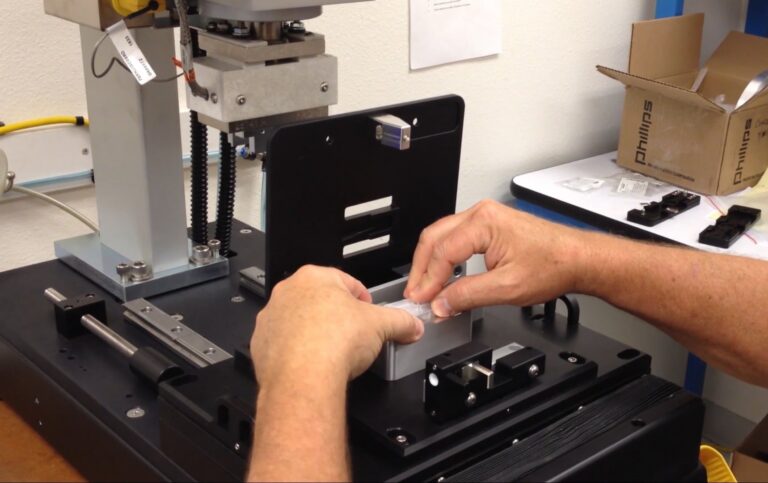
This video showcases a Thermal Press International H-Series machine used to heat stake the bezel for an automobile dashboard in a 2-up configuration. Automotive interior components such as dashboard bezels require precise alignment, consistent forming, and strong mechanical fastening to ensure durability, fit, and long-term performance under varying environmental conditions.
In this application, the bezel components are positioned within a custom-engineered nest designed to securely locate and support each part prior to the heat staking cycle. A specialized clamping mechanism ensures accurate placement and stability, preventing movement during processing and maintaining tight tolerances across both parts in the 2-up configuration.
During the cycle, controlled heat and pressure are applied to thermoplastic posts, reforming them into secure mechanical fasteners that bond the bezel to the underlying dashboard structure. The H-Series platform provides the force capacity and process control required for larger, more robust automotive components, delivering consistent and repeatable staking results.
To improve efficiency and operator workflow, the system incorporates a power shuttle table that allows for smooth loading and unloading while maintaining cycle consistency. This configuration reduces idle time, supports higher throughput, and enhances overall production efficiency.
Thermal Press International systems are widely used in automotive interior applications, including dashboards, instrument panels, trim assemblies, and control housings. With custom tooling, precise process control, and scalable system configuration, TPI delivers reliable heat staking solutions for high-volume automotive manufacturing environments.