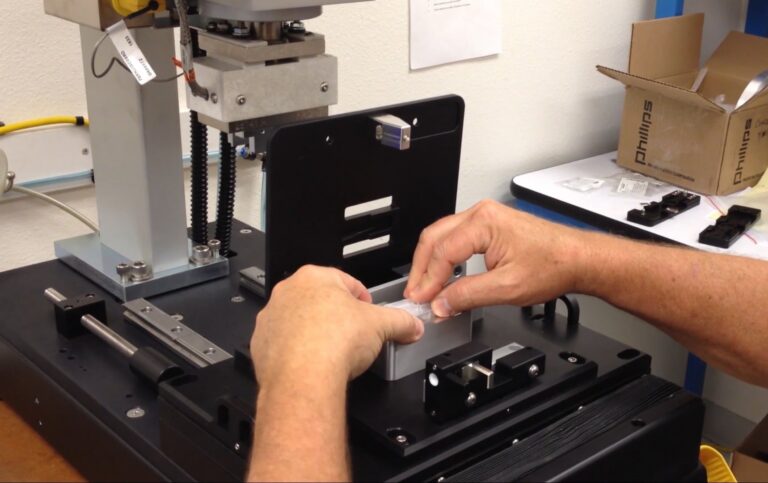
This video demonstrates a simulated production cycle of Thermal Press International’s In-Line Conveyor Thermal Press operating within a SMEMA-compatible automated manufacturing line. The system is designed to integrate directly into conveyorized assembly environments where consistent throughput, repeatability, and minimal manual handling are critical to production efficiency.
In this application, a pallet carrying a high-density LED array assembly advances along the conveyor and is automatically transferred into the heat staking station. Once in position, the pallet locks precisely into place to ensure repeatable alignment. The daughter pallet then elevates the LED assembly into the thermal staking zone, where controlled heat and pressure would be applied to form secure plastic stakes that retain and protect the electronic assembly.
This type of automated thermal assembly process is ideal for sensitive electronic products such as LED lighting modules, control panels, displays, and other component-dense assemblies where accurate positioning and process consistency are essential. By automating pallet transfer, locating, and part presentation, manufacturers can reduce labor requirements while improving cycle time and overall line efficiency.
Thermal Press International’s In-Line Conveyor Thermal Press is engineered for seamless integration with SMEMA-compliant automation systems and can be customized for a wide range of heat staking, insertion, swaging, and sealing applications. It provides manufacturers with a robust solutions for high-volume production environments requiring dependable, validation-ready thermal assembly performance.