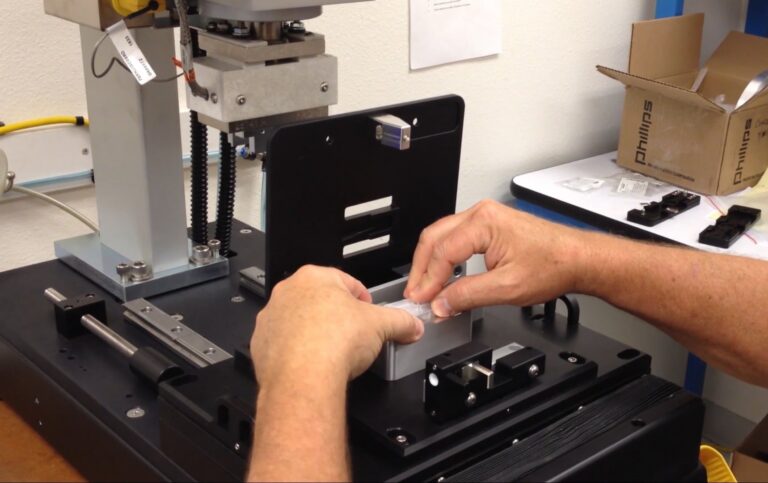
This video features a C-Series Thermal Press configured to heat seal a small filter membrane within an intricate medical device assembly. Applications like this require precise control of heat, pressure, and positioning to ensure consistent sealing performance without damaging delicate components.
The system utilizes a customized locating device and precision-engineered nest to accurately position both the medical device and the filter membrane prior to sealing. This ensures proper alignment and repeatability, which are critical when working with small, sensitive materials and tight tolerances.
Once loaded, the assembly is secured in place and the cycle is initiated. The power shuttle table advances the fixture into position beneath the thermal head, providing safe and efficient operation while maintaining consistent alignment from cycle to cycle. During the dwell phase, controlled heat and pressure are applied to form a reliable bond between the filter membrane and the device housing.
The tooling is specifically designed to support uniform sealing across the membrane without introducing distortion or compromising the integrity of the surrounding components. This level of process control is essential for medical device manufacturing, where seal consistency and part quality must meet strict performance and validation requirements.
Thermal Press International systems combine precise temperature control, repeatable force application, and custom fixturing to deliver dependable results across a wide range of heat sealing applications. This example highlights how tailored solutions enable manufacturers to confidently process complex assemblies while maintaining consistency, efficiency, and long-term reliability.