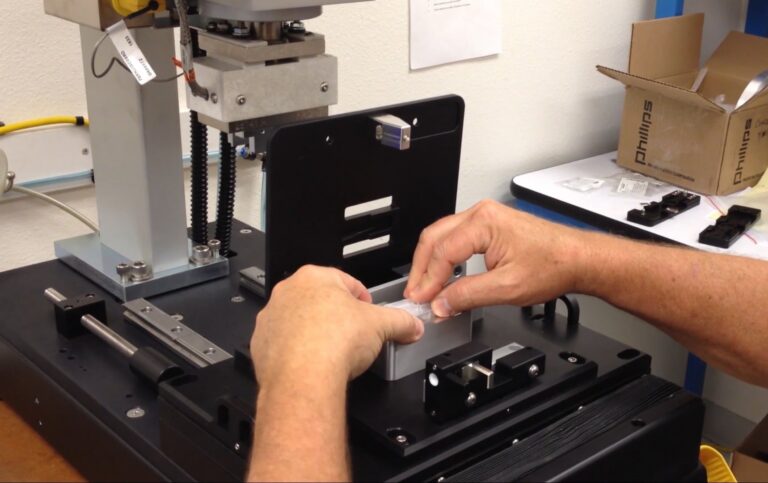
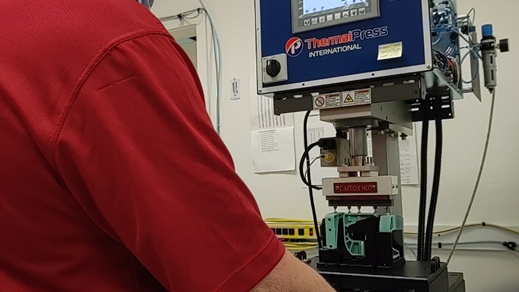
Heat staking is widely used in manufacturing as a reliable method for joining plastic components. Compared to screws, adhesives, and other fastening methods, heat staking offers advantages in strength, repeatability, and cost. Manufacturers often rely on specialized heat staking equipment to achieve consistent and repeatable results. In this article, we explore why manufacturers choose heat staking and when it is the best solution for plastic assembly.
Heat staking eliminates the need for extra hardware, which can be prone to defects, breakage, or other quality control issues. Moreover, fasteners tend to be more expensive and labor-intensive than heat staking, making the latter a more efficient and cost-effective solution for plastic assembly.
How Does Heat Staking for Plastic Assembly Work?
Heat staking is a straightforward yet effective process. When two or more components – at least one of which is made from thermoplastic – need to be joined, heat and pressure are applied to reform the plastic, creating a bond without the need for hardware. This method leverages the inherent strength of the plastic to secure the assembly, resulting in a solid, hardware-free bond.
The main advantage of heat staking over fastener-based technologies is that it can be performed in a single machine cycle and motion, whereas fasteners require individual operations for each attachment. Additionally, heat staking does not necessitate any changes to the base material, which can remain “as-is” while the plastic is reshaped to its final form. To better understand the fundamentals of this method, see our overview of the heat staking process.
Why Heat Staking Outperforms Ultrasonic Plastic Assembly
Unlike ultrasonic plastic assembly, which uses high-frequency vibrations to generate heat for bonding, heat staking is safe for use with sensitive electronics and offers superior pull strength. Ultrasonic vibrations can damage delicate electronic components, cause cold solder joints, or even lead to stress cracks in printed circuit boards.
In contrast, heat staking negates minimal mechanical stress, as it precisely controls temperature and pressure to reform the plastic at the contact point. Even glass-filled plastics, which are challenging for other techniques like cold staking, can be reliably joined through heat staking. The localized nature of the heating process also protects nearby electronics from damage.
Heat staking machines operate within tight temperature windows, making them ideal for complex and delicate applications in industries such as medical devices, automotive, telecommunications, and consumer products.
What Materials Are Best for Heat Staking?
Heat staking is compatible with a wide range of thermoplastics, including both native and blended varieties. It excels in producing high-quality results with materials such as:
- Polycarbonate (PC)
- Polypropylene (PP)
- Polystyrene (PS)
- Acrylonitrile Butadiene Styrene (ABS)
- Nylons (GFN or Nylon6/6)
- Ultem (GFN or Nylon6/6)
This versatility makes heat staking ideal for assembling LED Stamped Arrays or LED Flex Circuits into plastic housings for the automotive and aerospace sectors. It is also the go-to process for many medical device applications, such as attaching adhesive patches to wearable glucose monitoring and medicine dispensing devices, offering a softer, more comfortable feel compared to ultrasonic welding.
Additionally, heat staking’s ability to handle multiple assemblies in one machine cycle makes it a highly efficient and controlled option for production, outperforming other techniques in both speed and consistency.
The Importance of High-Quality Heat Staking Equipment
When investing in heat staking plastic assembly machines and tooling, it’s crucial to avoid inexpensive or “low-cost” options. These machines often struggle to maintain the precise temperature and motion required for consistent production. For optimal heat staking results, machines must operate within a precise temperature, motion, and force range – below the thermoplastic’s melt temperature – to achieve a reliable and repeatable assembly process.
At Thermal Press International (TPI), we take pride in designing machines that offer the accuracy and repeatability necessary to meet the stringent requirements of heat staking in precision manufacturing. Our equipment enables manufacturers to achieve precise heat staking requirements, resulting in tangible savings and improved product performance. You can also see these results demonstrated in real applications in our heat staking videos.
Contact Us: Contact Thermal Press International at (925) 454-9800 to speak with an engineer and explore how heat staking can optimize your manufacturing operations.